


June began with a nationwide conversation on environmental protection and climate change as Uganda joined the rest of the world on Thursday, June 5, 2026 to commemorate World Environment Day under the theme “Inspired by Nature. For Climate. For Our Future.”
At the Green Harvest Journal, reflections turned toward the critical intersection of environment and agriculture — a relationship that defines the country’s food security and resilience.
In an in-depth interview, Wilbert Ikilai, Assistant Commissioner for Environment, Education and Advocacy at the National Environment Management Authority (NEMA), explained how the Authority’s work from regulating chemicals to conserving wetlands and forests is directly tied to sustaining Uganda’s agricultural sector and ensuring that farming thrives in harmony with nature.
Environment and Agriculture: Two Sides of the Same Coin
Uganda’s National Environment Act (CAP 181) is the country’s cornerstone environmental law. It establishes NEMA as the principal agency responsible for coordinating, monitoring, regulating, and supervising all environmental activities, while also addressing modern challenges such as climate change, hazardous chemicals, plastics, and biodiversity conservation.
Ikilai emphasized that nearly all of NEMA’s interventions indirectly support agriculture.
“Almost everything NEMA does supports sustainability of the environment, and when you support the environment, you have supported the agriculture sector as well,” he said.
Regulating Chemicals to Protect Farmers
Ikilai pointed to NEMA’s role in regulating hazardous chemicals:
- Before pesticides or fertilizers are imported, they are assessed for safety.
- Harmful chemicals that threaten pollinators, soil fertility, or water quality are restricted.
- Annual environmental audits ensure industries comply with safeguards that protect farmland.
“Chemicals that would affect pollinators, chemicals that would affect biodiversity relevant to agriculture are regulated. By doing this, we are promoting agriculture in one way or another,” he explained.

He also noted that NEMA works closely with UNBS (Uganda National Bureau of Standards) to ensure chemicals entering the country meet safety standards, and with extension workers to educate farmers on safe usage.
“UNBS looks at the standards, beginning from the time of entry, even when they are here, UNBS does it. And then the Ministry of Agriculture is on top of the game. Together, we ensure that chemicals allowed are safe, regulated, and those that are banned are kept out,” Ikilai explained.
Wetlands and Forests: Nature’s Reservoirs for Farming
Wetlands and forests are central to Uganda’s agricultural resilience:
- Wetlands regulate rainfall and store water for irrigation.
- Forests influence precipitation, house pollinators, and sustain biodiversity vital for farming.
- NEMA’s enforcement against wetland encroachment is framed as protecting agriculture, not punishing communities.
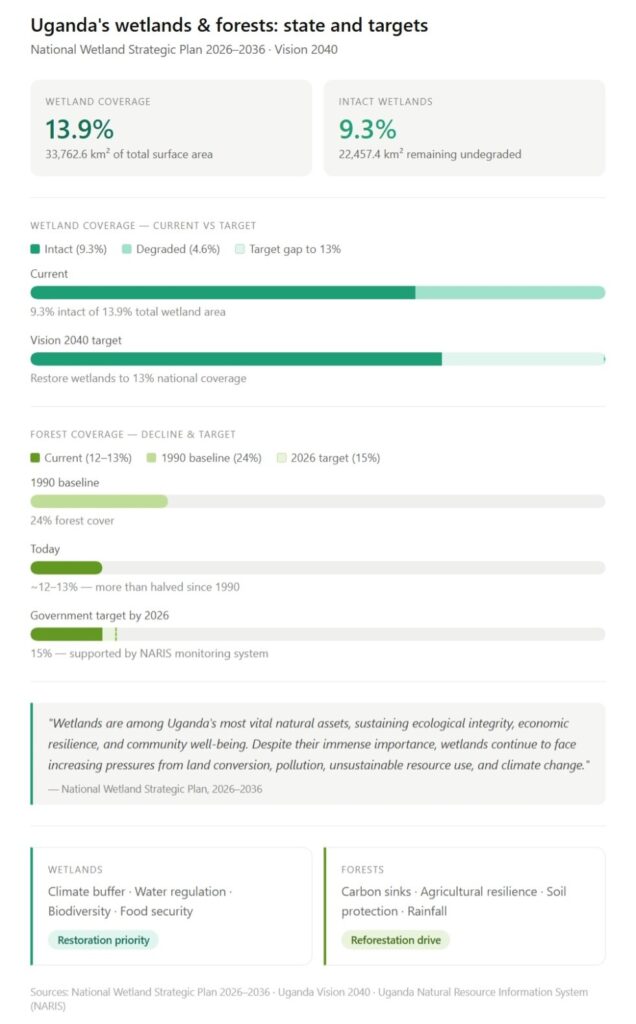
“Wetlands play a great role in the agriculture sector. They influence rainfall, they retain water, and when we have water, then we are able to do production in agriculture,” Ikilai noted.
He added that enforcement is ongoing across the country:
“Conservation of wetlands through NEMA’s enforcement means ensuring that those who are in wetlands are removed. If you refuse to leave the wetlands, we engage and ensure that you are not in the wetlands anymore. And it’s happening — even as we speak now, it’s happening somewhere.”
This underscores NEMA’s position that eviction is not about denying land, but about preserving ecosystems that sustain agriculture.
Climate Change and Cleaner Air
Ikilai highlighted NEMA’s role in climate change mitigation, stressing that environmental protection is inseparable from agricultural productivity:
- Banning open burning of waste to reduce carbon emissions.
- Promoting renewable energy and clean cooking solutions to improve air quality.
- Advocating for green transport to cut pollution and reduce reliance on fossil fuels.
Cleaner air, he emphasized, directly supports plant growth and agricultural resilience.

“Smog has the effect of reducing the growth rate of plants. When we work towards cleaner air, we are supporting plant growth and, in turn, agriculture,” Ikilai explained.
He also pointed to the need for reform in Uganda’s public transport system as part of climate action:
“We are now promoting issues to do with green transport. Let’s move away from fuel-dependent vehicles. Cities should have bigger buses that use cleaner energy sources instead of these too many taxis. Group transportation reduces emissions and supports sustainability,” he said.
This approach, Ikilai argued, is not only about reducing pollution but also about creating a more efficient transport system that aligns with Uganda’s broader climate and agricultural goals.
Awareness and Behavioural Change
Ikilai believes that awareness precedes accountability, and that lasting change in Uganda’s agriculture-environment relationship must begin with shifting mindsets. NEMA’s campaigns therefore go beyond enforcement — they focus on storytelling, education, and everyday practices that shape how communities interact with nature.
- Images of degraded farmland or floods mobilize policymakers faster than reports.
- School environment clubs teach children waste management and sustainable practices.
NEMA has taken this message to schools, where environment clubs are nurturing a new generation of stewards:
“We feel that this is where the majority of young people are. When they begin changing practices — managing waste, avoiding littering — we are bringing up a generation that will grow with environment stewardship in their minds,” he said.
- Behavioural change campaigns encourage alternatives to single-use plastics, reducing land pollution that harms agriculture.
Ikilai was candid about the importance of changing habits:
“Behavioural change is not a single day’s activity — it is something we need to continue engaging. We want people to begin using alternatives, to reuse, to prolong the use of items. If people adopted these practices, we could reduce littering, reduce pollution, and save our land,” he explained.

He pointed to NEMA’s ongoing push against single-use plastics, noting that the campaign is as much about changing consumer behavior as it is about legislation:
“Kavera honestly is a menace to our land, and when it is a menace to the land, then it affects the agriculture sector. But we have to start with behavioural change, and that is where we are currently,” Ikilai stressed.
NEMA has taken this message to schools, where environment clubs are nurturing a new generation of stewards:
“We feel that this is where the majority of young people are. When they begin changing practices — managing waste, avoiding littering — we are bringing up a generation that will grow with environment stewardship in their minds,” he said.
Through these initiatives, Ikilai underscored that awareness campaigns are not peripheral to agriculture — they are central to sustaining it.
Community Engagement
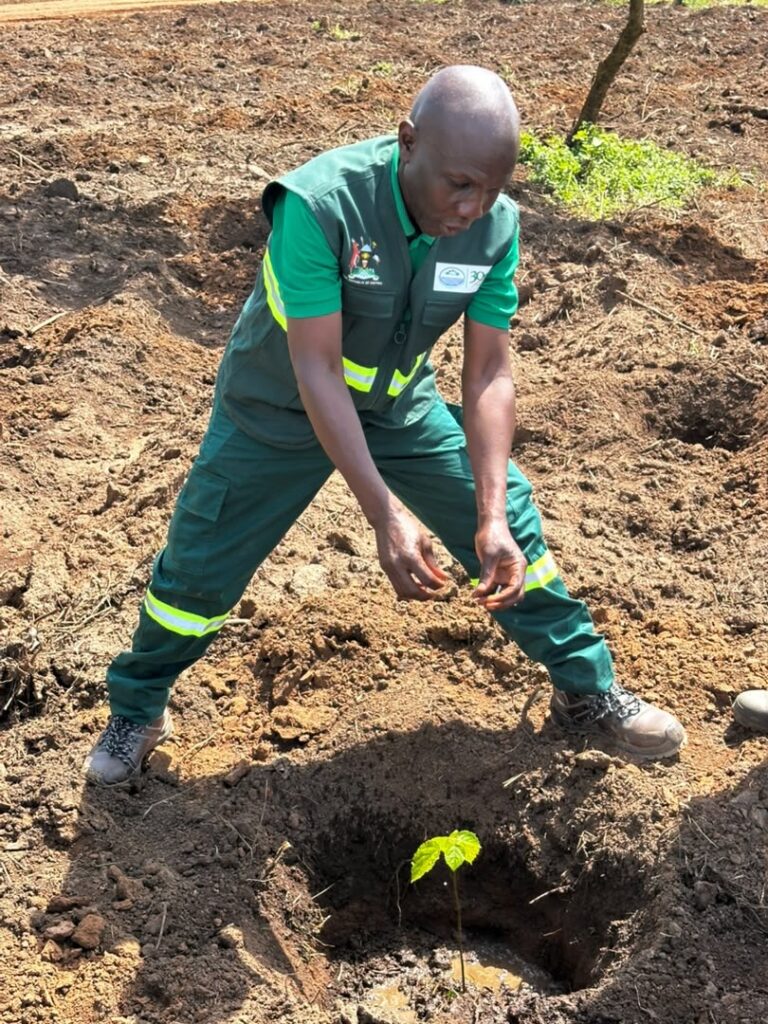
NEMA works with local governments, extension workers, and lead agencies to reach farmers directly:
- Promoting mulching, terracing, and organic pesticides.
- Supporting irrigation, water harvesting, and climate-smart agriculture.
- Engaging communities in clean-up campaigns and sustainable land use practices.
“We have supported regional engagements of communities in wetlands, showing them alternatives like fish farming or horticulture, so they can sustain livelihoods without destroying ecosystems,” Ikilai explained.
The “So What” Conclusion
This year’s theme “Inspired by Nature. For Climate. For Our Future” is not abstract for Uganda. It is a direct call to protect the agricultural backbone of the nation. Ikilai’s message is clear: Uganda’s food security depends on environmental stewardship.
So what? If Uganda fails to protect its environment, it risks undermining its agricultural future. But if it succeeds, it ensures that farming thrives in harmony with nature, feeding generations to come.
